Operations
How strong enforcement programs reduce friction before a complaint is filed
The best takedown programs start before escalation. Clear ownership records, evidence standards, and platform routing logic reduce delays and improve complaint quality from the first submission.
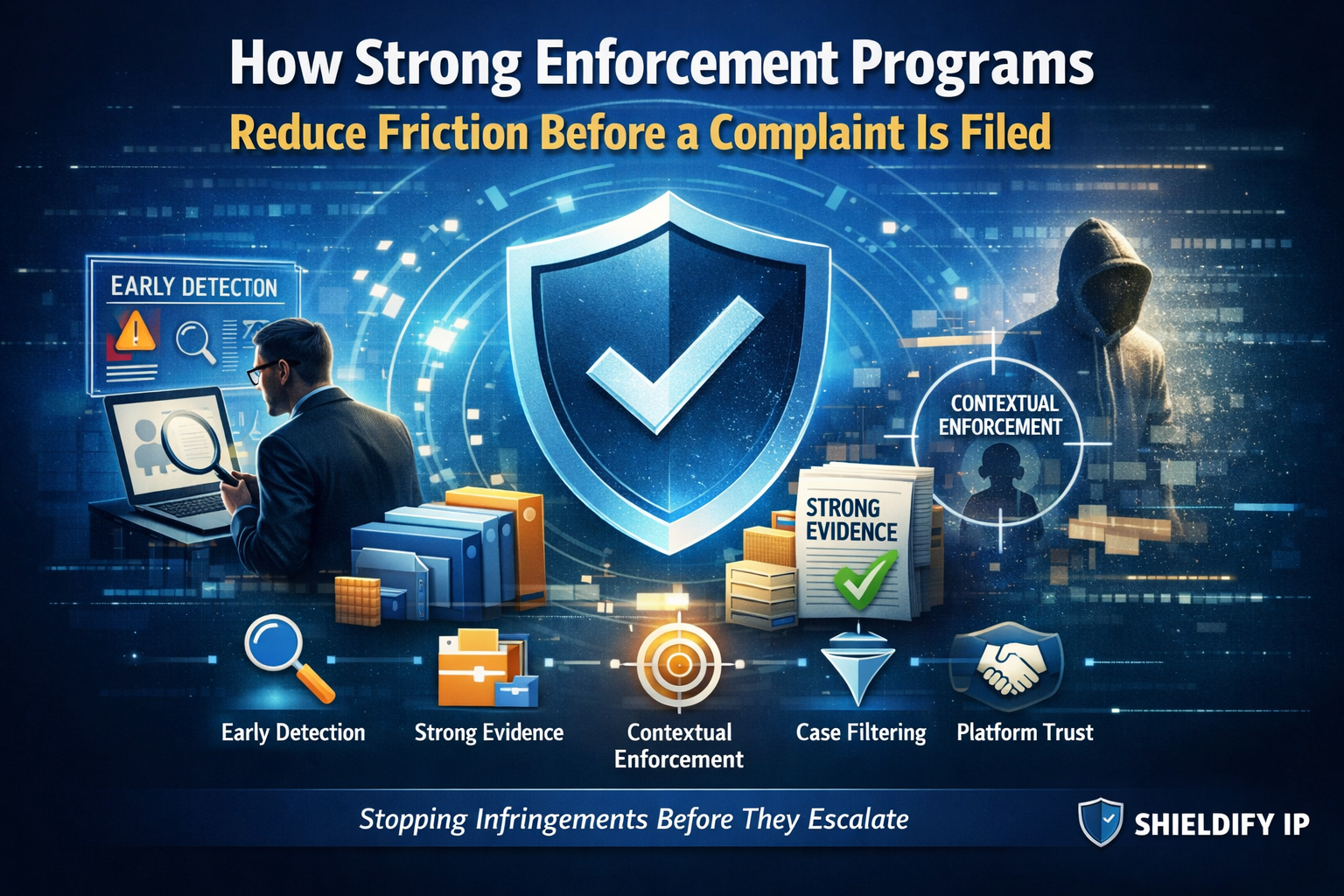
In today’s digital landscape, brand abuse rarely begins with a formal complaint. It starts quietly — a misleading post, a disguised abbreviation, a counterfeit listing, or an impersonation account operating just below enforcement thresholds. By the time a complaint is filed, damage has often already been done.
This is where strong enforcement programs create a measurable advantage.
Rather than reacting to violations, leading organizations deploy structured, proactive enforcement systems that identify, assess, and neutralize risks before escalation is required. The result is not just faster takedowns — but significantly reduced friction across the entire enforcement lifecycle.
At Shieldify IP, we view enforcement as a pre-emptive discipline, not a reactive process.
1. Early Detection Eliminates Escalation
Most enforcement friction originates from delayed visibility. When violations are detected late, evidence becomes weaker, content spreads wider, and platforms require more extensive review.
A strong enforcement program continuously monitors for both direct and indirect infringement signals — including obfuscated brand references such as abbreviations (e.g., TCB, VF, VPB, MNL), altered spellings, and contextual misuse.
By identifying these patterns early, enforcement actions can be initiated while:
Content reach is still limited
Platform risk signals are low
Decision thresholds are easier to meet
This dramatically increases the probability of fast, low-resistance removals.
2. Structured Evidence Reduces Platform Pushback
One of the most common sources of friction is insufficient or inconsistent evidence.
Without a structured approach, complaints often trigger:
Requests for additional documentation
Automated rejections
Delays due to manual review
Strong enforcement programs standardize evidence collection before submission:
Clear mapping between brand assets and infringing content
Contextual explanation of misuse (especially for non-obvious cases)
Pre-validated ownership and authorization records
This ensures that when a complaint is filed, it is already aligned with platform expectations — minimizing back-and-forth communication.
3. Contextual Enforcement Improves Accuracy
Modern infringement is rarely explicit. Bad actors intentionally avoid direct trademark usage, relying instead on indirect references, abbreviations, or suggestive language.
Traditional enforcement struggles in these scenarios because it relies on exact matches.
Shieldify IP addresses this through Contextual Enforcement™ — a methodology that evaluates:
Linguistic patterns and abbreviations
Visual-context relationships
Behavioral signals across accounts and content clusters
By establishing intent and association, even when trademarks are not explicitly stated, enforcement actions become both more precise and more defensible — reducing rejection rates and unnecessary disputes.
4. Pre-Qualification Filters Out Weak Cases
Not every violation should become a formal complaint.
Submitting weak or borderline cases creates friction by:
Lowering trust signals with platforms
Increasing rejection ratios
Consuming operational resources
A strong enforcement program includes internal pre-qualification layers that assess:
Legal strength of the claim
Likelihood of platform acceptance
Strategic importance of the case
Only high-confidence cases proceed to submission, ensuring a cleaner, more effective enforcement pipeline.
5. Operational Consistency Builds Platform Trust
Platforms respond more efficiently to enforcement partners who demonstrate consistency, accuracy, and professionalism.
Over time, a well-managed enforcement program:
Reduces the need for repeated verification
Minimizes automated scrutiny triggers
Improves overall response speed
This trust effect is cumulative — and it directly reduces friction before and during the complaint process.
Conclusion
Friction in enforcement is not inevitable — it is often the result of reactive systems, inconsistent evidence, and late-stage intervention.
By investing in a strong enforcement program, organizations can shift from reactive takedowns to proactive control — where most risks are addressed before they escalate into formal disputes.
At Shieldify IP, this philosophy underpins every solution we build.
Because the most effective complaint… is the one you never have to file.