Consumer brand
Coordinating repeat marketplace counterfeit complaints across multiple storefronts
A rights holder needed a more disciplined approach to recurring counterfeit listings appearing under different seller identities.
Case snapshot
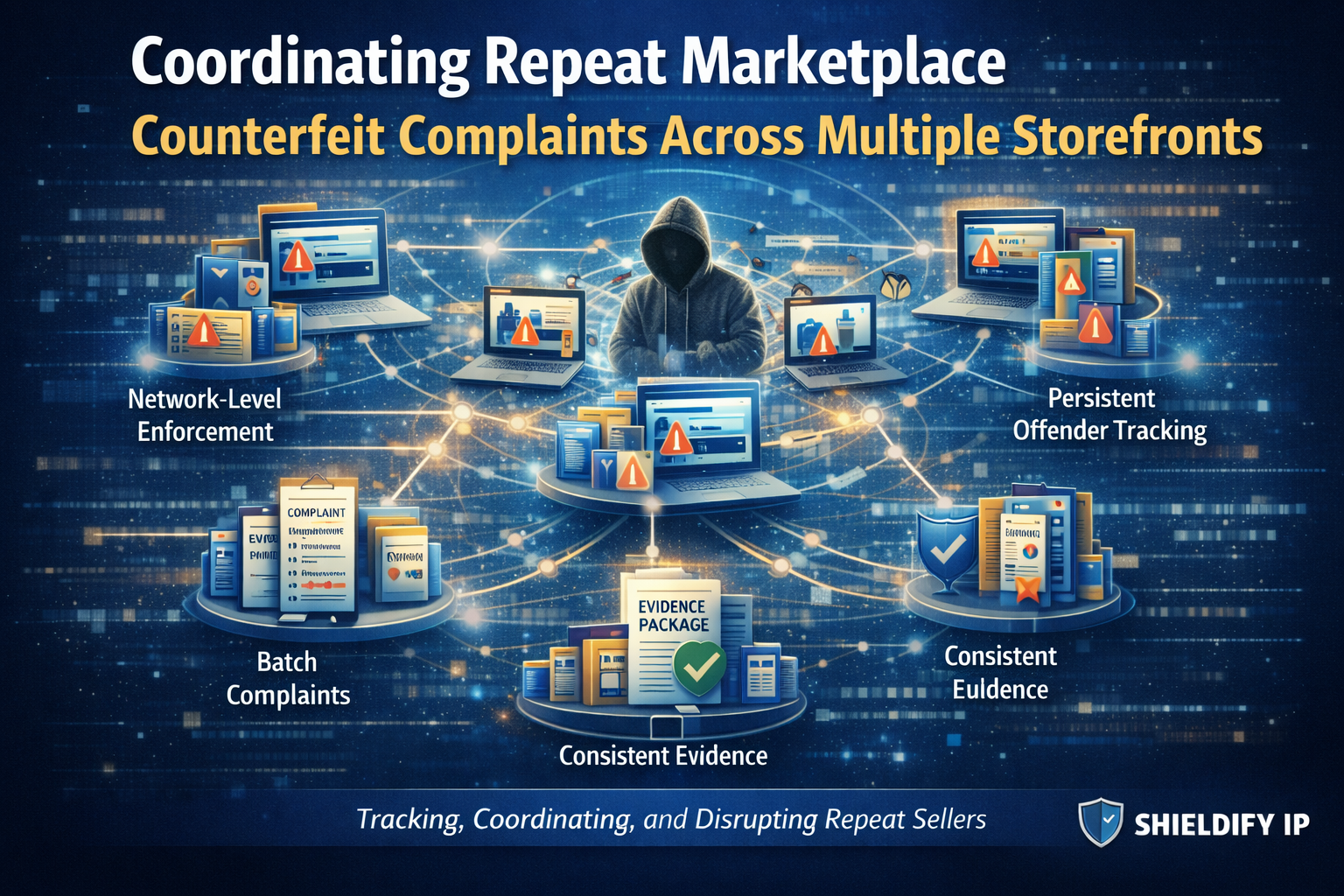
<p>Counterfeit activity in modern marketplaces is no longer isolated — it is distributed, adaptive, and persistent. A single bad actor can operate dozens of storefronts, relist removed products within hours, and continuously shift identifiers to evade enforcement.</p><p>Filing individual complaints against isolated listings is no longer enough.</p><p>To effectively combat repeat counterfeit activity, organizations must coordinate enforcement across storefronts, accounts, and platforms — treating infringement as a network, not a single event.</p><p>At Shieldify IP, we design enforcement strategies that scale with the complexity of the threat.</p><hr><h3>1. From Single Listings to Network-Level Enforcement</h3><p>Traditional enforcement focuses on individual URLs:</p><ul><li><p>One listing → one complaint → one removal</p></li></ul><p>But counterfeiters rarely stop there. The same product often appears across:</p><ul><li><p>Multiple storefronts</p></li><li><p>Duplicate seller accounts</p></li><li><p>Slightly modified listings</p></li></ul><p>A coordinated enforcement program identifies and links these touchpoints:</p><ul><li><p>Shared product images or descriptions</p></li><li><p>Reused contact details or fulfillment patterns</p></li><li><p>Behavioral similarities across accounts</p></li></ul><p>By mapping infringement as a network, enforcement shifts from reactive removal to systematic disruption.</p><hr><h3>2. Persistent Tracking of Repeat Offenders</h3><p>One of the biggest sources of friction is repetition — the same seller reappearing after every takedown.</p><p>Without tracking, enforcement teams are forced to start from zero each time.</p><p>Shieldify IP introduces persistent offender tracking:</p><ul><li><p>Internal case history tied to seller profiles and storefronts</p></li><li><p>Cross-platform identity correlation (where possible)</p></li><li><p>Reuse detection for images, text, and listing structures</p></li></ul><p>This allows enforcement teams to:</p><ul><li><p>Recognize repeat offenders instantly</p></li><li><p>Submit stronger, pattern-based complaints</p></li><li><p>Escalate cases with supporting history</p></li></ul><p>Platforms are significantly more responsive when repeat behavior is clearly demonstrated.</p><hr><h3>3. Batch Complaint Strategy for Scale</h3><p>Submitting complaints one-by-one creates operational bottlenecks and delays enforcement impact.</p><p>Coordinated programs leverage batch reporting strategies:</p><ul><li><p>Grouping multiple infringing URLs into a single structured complaint</p></li><li><p>Aligning submissions with platform-specific limits and formats</p></li><li><p>Prioritizing high-impact clusters of listings</p></li></ul><p>This approach:</p><ul><li><p>Reduces submission overhead</p></li><li><p>Improves reviewer efficiency</p></li><li><p>Accelerates large-scale removals</p></li></ul><p>When executed correctly, batch complaints can take down entire counterfeit clusters in a single action cycle.</p><hr><h3>4. Consistent Evidence Across Storefronts</h3><p>A fragmented approach to evidence weakens enforcement outcomes.</p><p>If each complaint presents inconsistent or incomplete information, platforms treat them as unrelated cases — even when they originate from the same source.</p><p>Strong coordination ensures:</p><ul><li><p>Standardized evidence packages across all storefronts</p></li><li><p>Consistent ownership and authorization data</p></li><li><p>Unified explanation of infringement patterns</p></li></ul><p>This creates a cohesive narrative that reinforces the legitimacy and urgency of enforcement actions.</p><hr><h3>5. Escalation Pathways for High-Risk Networks</h3><p>Not all counterfeit activity is equal.</p><p>Large, coordinated networks — especially those operating at scale — require escalation beyond standard reporting flows.</p><p>Shieldify IP integrates escalation strategies such as:</p><ul><li><p>Highlighting repeat infringement patterns across multiple complaints</p></li><li><p>Referencing prior report IDs and enforcement history</p></li><li><p>Leveraging trusted reporting channels where available</p></li></ul><p>By presenting a clear pattern of abuse, these cases are more likely to receive higher-priority review and decisive action.</p><hr><h3>Conclusion</h3><p>Counterfeit enforcement is no longer about removing individual listings — it is about dismantling systems of abuse.</p><p>Without coordination, enforcement remains reactive, fragmented, and inefficient.</p><p>With a structured, network-level approach, organizations can:</p><ul><li><p>Reduce repeat infringement</p></li><li><p>Increase takedown efficiency</p></li><li><p>Regain control across marketplaces</p></li></ul><p>At Shieldify IP, we don’t just remove counterfeit listings.</p><p>We disrupt the infrastructure behind them.</p>
Read more